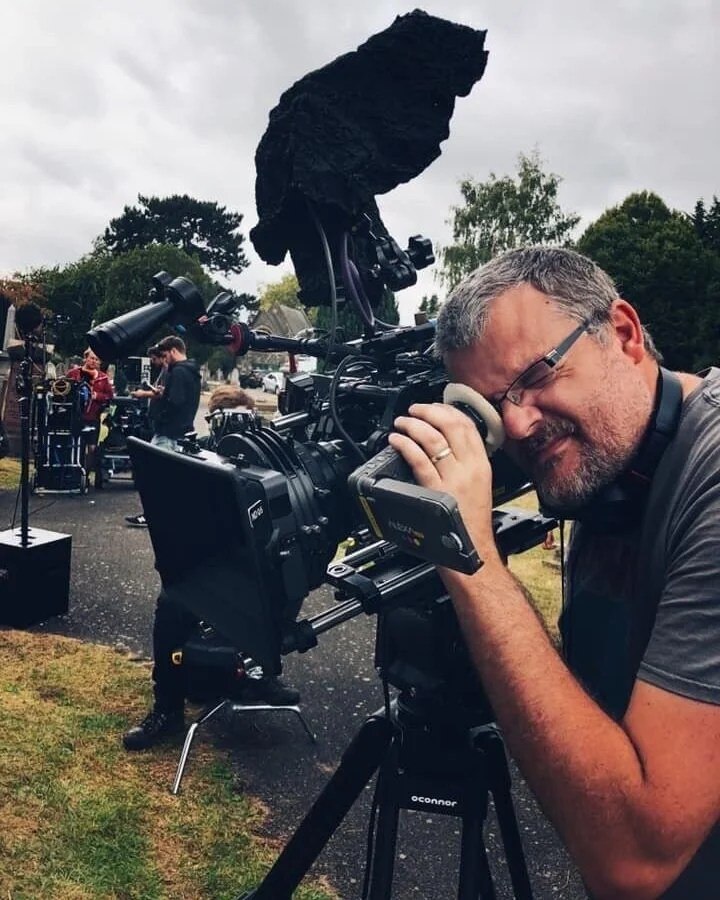
About the Guest
James Webber has worked professionally as a filmmaker for over 15 years, making numerous music videos, promos, and commercials. He has also written and directed several award-winning shorts.
James’ first feature film, the urban drama Sorority (Starring BAFTA winners Kate Dickie & Sophie Kennedy Clark), screened at numerous festivals around the world, and James was long-listed for a BIFA, marking him as a talent to watch. Sorority is now available to rent & buy on Amazon Prime Video.
His first major short, the highly acclaimed Driftwood, has won over 25 awards at international festivals, including a prestigious ‘Coup de Coeur’ at Cannes and was long-listed for both a BAFTA and a BIFA for ‘Best Short Film’. The film was picked up for distribution by Shorts International and, in the summer of 2014, it was broadcast on Channel 4. James’ follow-up to Driftwood was the drama short Soror, which hosted an impressive ensemble cast including double BAFTA winner Kate Dickie (Game of Thrones, The Witch).
Other credits include directing the horror short The Prey, which was sold to Crypt TV in the US. So far, the film has gained over two million views online and includes famed genre filmmaker Eli Roth (Hostel) as one of its fans. For director Axelle Carolyn (The Haunting of Bly Manor), James also produced The Halloween Kid, alongside Neil Marshall (The Descent, Game of Thrones), which premiered at Frightfest in 2012.
James’ commercial clients include Film4, Unilever, Disney, Google, Amnesty International, Media Trust, MasterCard, Clogau Gold, Spectra, SYDRC, Academy and Sony. In 2014, Webber co-founded The Springhead Film Company.
Selected Filmography
- Driftwood (Short) 2012
- Soror (Short) 2014
- The Prey (Short) 2015
- Sorority (Feature) 2022
- Untitled Feature (Shooting) 2027
Official Links & Trailers:
Website: www.directorjwebber.com |
Springhead Film Company: www.springheadfilmcompany.com
Instagram: @directorjwebber |
IMDb: James Webber IMDb Profile
Trailers:
Driftwood |
Soror |
The Prey |
Sorority
I. The Beginning of a Filmmaker
1. Looking back to your childhood in Bournemouth, what was it about cinema that first made you feel that filmmaking could become more than an interest—that it could become a way of understanding the world?
James Webber: I always had imagination. When I was a child, I don’t remember ever being bored. I could quite happily spend hours playing with my toys and telling my own stories with them. In many ways, this was my first experience of being a storyteller, albeit just to myself. I didn’t live near a cinema either when I was young, so going there was a big occasion. Most of my introduction to film was through renting VHS tapes and recording movies off of the television. One of my earliest memories is watching a VHS of Star Wars with my grandfather. I ended up wearing through the tape because I watched it so much. My love really grew from there, and by the time I was a teenager, I was completely obsessed. It took a while for me to realise that it was perhaps something I could do for a living.
2. You studied Audio Visual Production at Arts University Bournemouth and then spent years making shorts, promos, music videos and commercials. What did those early years teach you that no classroom could?
James Webber: Although I learnt some important lessons at Bournemouth, it was making my own short films that was really my education. You get to try things out and make mistakes and then learn from those mistakes. You also get to experiment with the kinds of stories that you want to tell. I worked in a Blockbuster video for a few years as well, which opened my eyes to all kinds of cinema from around the world. I devoured my 7 free rentals a week and watched a wide selection of films, good and bad, soaking up everything.

3. Before recognition arrives, a filmmaker can spend years making work without knowing exactly where it will lead. Was there a particular moment when you realised you could genuinely build a life around directing?
James Webber: When I started making my short film Driftwood, that was the turning point. I approached the film completely committed to not cutting any corners whatsoever and to make it look like 10 mins taken from a longer, large-budget production. At this point, I felt I made the transition into actual directing, and I haven’t looked back ever since.
4. After all these years, what part of the filmmaker you were at the beginning of your journey is still very much alive in you?
James Webber: I’m still passionate about movies as I was when I was younger (arguably, more so). I’ve been full-time in the industry now for 16 years and, as any freelance creative will tell you, there can be difficult moments. It is always at this point that I go back to the films that inspired me when I grew up, and it almost restores your faith in the path you are walking. As cheesy as it sounds, no matter where I have been in my life, cinema was always there for me.
II. Finding a Voice Through Short Films
5. Driftwood became a major turning point, receiving the Cannes ‘Coup de Coeur’, a BAFTA long-listing and wide festival recognition. What did making that film reveal to you about your own voice as a director?
James Webber: It helped me have more confidence in my vision and approach. It provided me with the basic grounding that I’ve taken onto every project ever since.
6. Driftwood places a young athlete between talent, achievement, fear and the pressures of everyday life. What drew you to that emotional tension, and how did you turn it into visual storytelling?
James Webber: Driftwood was really envisioned for a film festival audience, and over the years I had been to quite a few events and watched a great many short films. I noticed that audiences responded the most to underdog stories, especially in the UK where we love a rags-to-riches story. So I set out to tell my own, working in the fact that I had always wanted to shoot underwater scenes. Writing the script took a while as I wanted to make a story that would fit into a neat 10 min time slot but also contain a classic 3-act structure. Which isn’t easy in that running time. Eventually I hit upon the idea of making the film tell 3 separate mini-stories about the same character, showing different aspects of his life. These small moments would then weave into each other, each building to a crescendo at the end. Whilst writing, I also sketched out shots so that the visual elements were really baked into the finished article.
7. When Driftwood began reaching Cannes, festivals, distribution and television, did that recognition change your ambitions—or mainly confirm what you already believed about the film?
James Webber: I was ambitious when I set out to make the film, but I was still taken aback at how far it went. As soon as the film hit the festival circuit, it took on a life of its own and started creating its own opportunities. I had never experienced that before. I received invites to festivals all over the world, and some even kindly paid for me to travel there and attend, such as the Salento Film Festival in Italy. If you can travel to beautiful places and watch some amazing films made by other creatives… Well, it’s not a bad deal at all!
8. After working mainly in drama, you moved into horror with The Prey. What were you hoping to discover about yourself by entering a genre with such different rules and expectations?
James Webber: Horror has always been one of my favourite genres, and I’ve always wanted to dip my toes into it. Also, it was quite cathartic to do something a little silly with blood and gore after the serious tones of both Driftwood and Soror. But I loved learning new aspects of the craft; experimenting with CGI and make-up effects.
III. Image, Emotion and the Director’s Eye
9. You describe your work as specialising in arresting visuals and powerful dramatic content. What makes an image emotionally powerful to you rather than simply beautiful?
James Webber: It’s an image I can’t shake. Something that’s burnt into my imagination. It might have been something I saw in passing or experience first hand. I think as a storyteller who writes and directs, you file these little moments away, waiting for the right day to unpack them. Often it is the oldest visuals that endure, and then I know there is a larger idea in there for me. Quite often it is an image that makes me ask questions. For Driftwood, I had an image before the script existed of a young man with a tower block looming behind him. He looks lost in thought, completely at odds with his surroundings. Over a few years, I would revisit the idea, adding a little bit more until there was a script. But it all boiled down to that original image. It fascinates me that a small idea can one day become something so much bigger, even if it takes years to do so.
10. When you begin a scene, where does its visual language usually come from—the script, the character, the location, the cinematographer, or something you discover on the day?
James Webber: I think it is a combination of all things. Obviously, everything starts with a script, but from there it mushrooms out. HOD’s, especially the cinematographer, will also have ideas. It’s then my job to bring everything together and refine it into a cohesive approach. But there is also something to be said about incorporating new visual ideas on the day. Sometimes they turn out to be the best moments so always remain open-minded.
11. How consciously do you use framing, camera movement, silence, sound and rhythm to tell a story before dialogue explains anything?
James Webber: I enjoy the camera being quite fluid and moving. I’m also a fan of shooting at different speeds, especially in moments of high emotion. Although I probably need to suppress some of these visual urges at times, it’s important to always push yourself into trying new things and not relying on your first creative impulse.
12. What is something you deliberately leave open or unexplained because you believe the audience should be trusted to complete the story for themselves?
James Webber: I think questions are a good thing, as it helps the audience engage more with the story. You basically meet them somewhere in the middle of the plot. Hopefully there will be enough breadcrumbs for them to fill in the blanks, almost subconsciously. That’s the goal at least! Also, life doesn’t necessarily wrap itself up neatly. There are rough ends, and false starts and a great many other things.
IV. From Soror to Sorority
13. Sorority grew from the earlier short Soror. What made you realise that this story had a life beyond the short-film format?
James Webber: Actually, it was the other way around. I had a larger idea for a feature film and then experimented with the elements in a short film format. At the time, both Driftwood and Soror were taken from a single, larger script that featured multiple characters and stories diverging. Ultimately, the project was just too big and through the short film process, it helped me see that.
14. When expanding a short into a feature, there is a danger of simply making a smaller story longer. What did you have to deepen, rethink or reinvent to make Sorority work as a feature?
James Webber: The great thing about making the short and then the feature was that I had time to look at the story and work out what I liked and, with the luxury of hindsight in mind, what I’d like to change or expand upon. It gave the characters room to breathe and grow without the limitations of a shorter running time. I wanted the characters to be different in the feature, not just an impression of what had been done before. Bar Kate Dickie, I brought in a new cast who were all keen to make their own mark on the film. The feature is a much more emotional film, and it moves into more difficult territory. I felt it was important to up the stakes overall.
15. Sorority explores sisters, family history, separation and the possibility of moving forward. Why do complicated family relationships continue to offer such powerful dramatic territory?
James Webber: Truth be told, I have a rather complicated family and, in a way, there is always a little bit of personal truth in the scripts I write. I think it was Spielberg who said: “I’ve avoided therapy because movies are my therapy.” I agree with that sentiment. But then again, if you write from a place of experience, then the work should hopefully resonate more, especially with those who have experienced similar things. Of course, there is still a degree of complete fiction to the films I make, but my own experiences sometimes provide the glue to hold it all together.
16. As both writer and director, you carried the story from the page to the screen. Did that give you greater freedom, or did it sometimes make it harder to step back and judge the material objectively?
James Webber: Both! You need to be able to approach your writing in the way the story and the characters deserve, but also keep one foot in what is actually possible to achieve in terms of budget. I purposely wrote in elements that I knew were open to me and absolutely doable in the short space of time we would have to shoot the film. The first draft was wildly different from the finished film, which is not uncommon. It had a death in the third act and really finished as a very different story than it had seemed at the beginning. It didn’t work. My agent at the time read it and gave me invaluable feedback to let the characters be true to their nature, let them breathe within the plot. On the next draft, I followed her advice and removed certain elements from the third act, and it worked so much better. It felt authentic to who the characters were and where I felt they were going.
V. Actors, Collaboration and Trust
17. What do you look for in an actor beyond technical ability when deciding that they are right for a character?
James Webber: I have to feel that I can not only collaborate with them but also get along in general! Making a film is a long process and can involve blood, sweat and tears, so having that fundamental respect throughout the experience is so important.
18. When working with experienced actors, how do you give them enough freedom to surprise you while still protecting the heart of the script?
James Webber: I want the actors to put their stamp on a character. The script is really just the starting point, and I’ve never been precious about tweaking things if it feels right to do so. Soror in particular was improvised, so this approach was hugely important. And quite often I find that those little surprises or completely unplanned moments that slip into that final edit are often my favourite parts of the film. I’ve been lucky to work with some phenomenal cast such as Kate Dickie, Sophie Kennedy Clark and Neil Maskell (plus many, many more) and, if you cast the right people, they never take that level of freedom for granted. It is all about the character and what feels real and believable in that moment.
19. You have built long-term creative relationships through The Springhead Film Company. What have those relationships taught you about the difference between assembling a crew and building genuine trust?
James Webber: I think you need to find your people, your tribe. Over the years, I’ve been able to do that, certainly behind the camera. It makes the process much easier and also means you are all on the same wavelength from day one.
20. Can you remember a moment when an actor or another collaborator changed something you had imagined—and made the film better because of it?
James Webber: To be honest, this happens all the time! When you work with the right people, you need to know when to deviate from a plan to incorporate a better idea.
VI. The Reality of Independent Filmmaking
21. Independent filmmaking is often described as creative freedom, but the reality also involves finance, schedules, logistics, distribution and compromise. Which part of that reality has surprised you most?
James Webber: Creative freedom, truthfully, is incredibly rare. Most filmmakers are carefully juggling budget and schedules, and trying to bend their own creativity into this box. It’s a tricky tightrope to walk. I think the biggest surprise for most filmmakers is the distribution side of things. It was certainly a lesson for me on my first film. There is so much focus on raising funds, securing actors and actually making a film happen that you can overlook what happens when the film is actually finished. Having been through that process once, I now have a much clearer idea of what I’d like to do with my second film.
22. You have experienced crowdfunding, independent production, festival strategy and distribution. What have those experiences taught you about balancing artistic ambition with financial reality?
James Webber: Crowdfunding was a massive part of my growth as a filmmaker. Without that experience, I wouldn’t have had half the opportunities over the past 10 years. But funding aside, running a campaign (which is a lot of work!) can act like a marketing opportunity for your film. The Driftwood campaign went wider than we could have possibly hoped, so much that some festivals had already heard of the film when we submitted it. I believe this certainly helped our festival run immensely. Crowdfunding isn’t just about asking for funding; it’s an extension of the film itself, and everything you do should be in keeping with that.
23. At what point does a practical production compromise become a creative compromise—and how do you decide when to fight for an idea and when to let it go?
James Webber: If you want to be ambitious, you will often come up against issues. I try to form ideas that hopefully can avoid compromise. But sometimes, you simply have no choice. Occasionally compromise can lead to happy accidents and better ideas. It’s not always a bad thing.
24. What do you wish writers and directors understood about the business side of filmmaking before attempting their first serious independent feature?
James Webber: Learn how things work on the backend of a production. Sales agents. Distribution. Marketing. You don’t have to become an expert in all of these, but having an understanding will help you no end. For general advice, I would say that prep is everything. Even if you secure your funding, don’t rush headlong into a shoot. Prep everything because on the shoot, especially on a low or micro budget, it’ll save you time and money – 2 things you won’t have much of.
VII. Building The Springhead Film Company
25. You co-founded The Springhead Film Company to make interesting, challenging and highly visual films with a collective of creatives. What did you feel was missing that made building such a company worthwhile?
James Webber: In truth, the company was never solely meant to be a home for just my films, but projects for other creatives as well. Although we have supported a few other directors, I’d love to expand this aspect of Springhead in the future.
26. What makes collaboration genuinely productive rather than simply democratic when several strong creative voices are working on the same film?
James Webber: I think if everyone is working towards the same goal, that’s the best way any creative relationship can start. That way, a collaborator may come at an issue from a different angle, but ultimately you all want the same thing. A great film.
27. After many years in the industry, what have you learned about choosing collaborators—not only for their talent, but for the way they think, communicate and handle pressure?
James Webber: Sets can, at times, be quite intense places, especially when shooting difficult or emotional scenes. Being focused but a nice person also makes the overall experience more enjoyable and rewarding in my opinion. We’re all in this together, and film, in its essence, is a collaborative art form. So you really want to work with team players across the board.
28. If you could redesign the independent filmmaking ecosystem from scratch, what would you change first to give distinctive filmmakers more room to take meaningful creative risks?
James Webber: Due to the complexities of the question, this deserves a much larger answer than I can probably give, but certainly, in the UK, I’d love to see a more viable approach to supporting filmmakers and new talent. Other countries are way ahead of us and see film as an art form. We aren’t quite like that in this country. Funding bodies feel like a closed club where the money often goes to the same people or to projects that fail to even gain an audience. Nepotism is rife, and filmmakers from a working-class background often get left out of this process. Medium-budget films have died a death, and low-budget projects are increasingly harder to fund. I know this paints a bleak picture and, despite everything I’ve just said, I still have hope. I see a lot of fellow filmmakers producing incredible work truly independent from any of the traditional sources or systems. It inspires me. And I hope one day, this work will be seen as widely as it deserves.
VIII. Recognition, Failure and the Long Game
29. Your career has included Cannes recognition, BAFTA and BIFA long-listings, international festivals, television, digital distribution and commercial work. Which achievement has meant the most to you personally, and why?
James Webber: Awards are nice and everything, but it is the buzz of sharing your film with an audience that is the true reward. We first screened Driftwood at BAFTA before it headed off on the festival circuit, and it was a wonderful experience to share the film with a larger number of people who had crowdfunded the short. Without them, we wouldn’t have a film, so I was nervous and hoped they would feel happy with their donation (And not want a refund!). The film went down really well, and it was a special night for me personally. I have put almost a year of my life into making Driftwood, and to see it play in front of a crowd for the first time was very special.
30. Recognition can be encouraging, but it can also create expectations. Has success ever made you question what you should make next?
James Webber: Not really. I’ve always been drawn to the stories that I want to tell. You want people to be able to watch and enjoy a project you’ve made, but I’ve tried to remain quite single-minded about the stories I’ve wanted to tell.
31. You have spoken about the value of feeling a degree of nerves before a project. What can fear tell a filmmaker about a project that excitement alone cannot?
James Webber: Nerves tell me that a project is 100% right for me to pursue. It presents a challenge to me. If I didn’t get that sensation, then I’m probably playing it safe and not pushing myself as a creative. It’s a barometer that has served me well over the years, so I continue to pay attention to it!
32. What has been your most valuable creative failure—the decision, project or mistake that taught you something success never could?
James Webber: I had a feature project fall through a few years ago which was close to happening. It was a huge lesson to learn, and I know most filmmakers are probably stung by this happening at some point in their career. But for me, it was a horrible experience. I put all my eggs in one basket, which you should never do. Now, looking back, I feel I may have actually dodged a bullet and had much better experiences, including my first feature, Sorority, that came as a direct result of that failure. So with that all in mind, perhaps it isn’t actually a failure at all! Production across Sorority was an absolute dream and was relatively smooth and enjoyable. Even the first investor we met with ended up paying for the whole film! I never would have had that experience if the other film had happened.
IX. The Second Feature and the Filmmaker You Are Becoming
33. You are now moving into your second feature. How is the filmmaker entering this production different from the person who made Sorority?
James Webber: I feel more comfortable taking a few more risks with this new film. The visual language we are creating is more complex and rich too. Having the previous experience behind me certainly helps when pushing things a little further.
34. After experiencing a first feature from writing and production through festivals and distribution, what did you consciously decide to do differently this time?
James Webber: The experience of Sorority was quite challenging when the film was finished due to COVID, so I’m hoping that with this new film we can achieve a lot of the things that we simply weren’t able to with Sorority, certainly in terms of release and a festival journey.
35. Has Sorority changed what you are willing to risk with your second feature—in story, structure, performance, visual language or subject matter?
James Webber: 100%. Whilst I don’t want to reveal the story just yet, my new film leaves a lot to the audience’s perception of the story. In some ways, it is quite a high-concept idea whilst also being completely personal to me. There are certainly some themes in common with my earlier work but also a new exciting space that I’m having fun exploring.
36. Without revealing anything you would prefer to keep private, what question about filmmaking are you hoping this second feature will allow you to explore that you could not explore before?
James Webber: I’ve never made a love story before, and this certainly has elements of that. I wanted to explore not only passion and what draws two people inexplicably together for the rest of their life but also the tougher elements of a long-term relationship, to show it honestly with all the ups-and-downs that a modern couple experiences along the way.
X. Cinema, Audience and What Comes Next
37. Independent cinema now has tools and distribution possibilities that previous generations could hardly imagine, yet attention has become extremely difficult to earn. What do you think independent filmmakers misunderstand about the current landscape?
James Webber: It’s never been easier to make a feature film, which is mostly a good thing. You can learn how to make films without going to film school. The bad thing is that there is just so much content of all kinds out there. It’s incredibly difficult to stand out or for your work to be even found. That’s why finding your own original voice is so important when it comes to making an impact anywhere.
38. With streaming, social media, AI-assisted tools, changing theatrical economics and fragmented audiences, what do you believe will remain fundamentally human about cinema?
James Webber: Cinema is storytelling, which is one of the most human expressions. It’s a communal thing. First it was stories around a campfire; now it is sitting in a dark IMAX cinema. There is something intrinsically beautiful about that shared experience. Laughing or crying or being engrossed alongside complete strangers. And, despite the challenges the industry faces, I feel that human-created films will always have a place.
39. What kind of film do you think is becoming harder to make today—and therefore perhaps more important to make?
James Webber: I feel that making straight drama films is always the most challenging genre to get off the ground. Unlike the horror genre, which has a dedicated fanbase at almost every level, drama is less popular and, as a result, harder to fund. However, I firmly believe telling human experience stories is incredibly important and deserves an audience.
40. Finally, if someone discovers your work twenty years from now and watches Driftwood, Soror, The Prey, Sorority and whatever comes next, what would you hope they understand about the filmmaker behind those films?
James Webber: Truthfully, I don’t really know. I’ve never really thought about a filmmaking legacy! I just want people to enjoy the stories I tell, and I want to continue making them for as long as I can!
HELP KEEP IDEAS ALIVE
Great ideas deserve to be heard, preserved, and passed forward.
Astra Global Ventures exists to bring thoughtful conversations, original perspectives, and meaningful stories into the world—and to preserve them for readers today and generations to come.
If this work has meant something to you, please consider supporting our independent publishing work. Your contribution helps us continue the research, editing, design, and publishing that bring meaningful voices and ideas to life.
Every contribution, whatever its size, helps us keep creating and sharing work that matters.
SUPPORT INDEPENDENT PUBLISHING
For international supporters, you can contribute securely through PayPal:
Scan the QR code or use the PayPal link below to support our independent publishing work.
Support Astra Global Ventures via PayPal
Thank you for helping meaningful ideas live beyond the moment.