Painting the Invisible: A Conversation with Esther Claus
Read Biography ▼
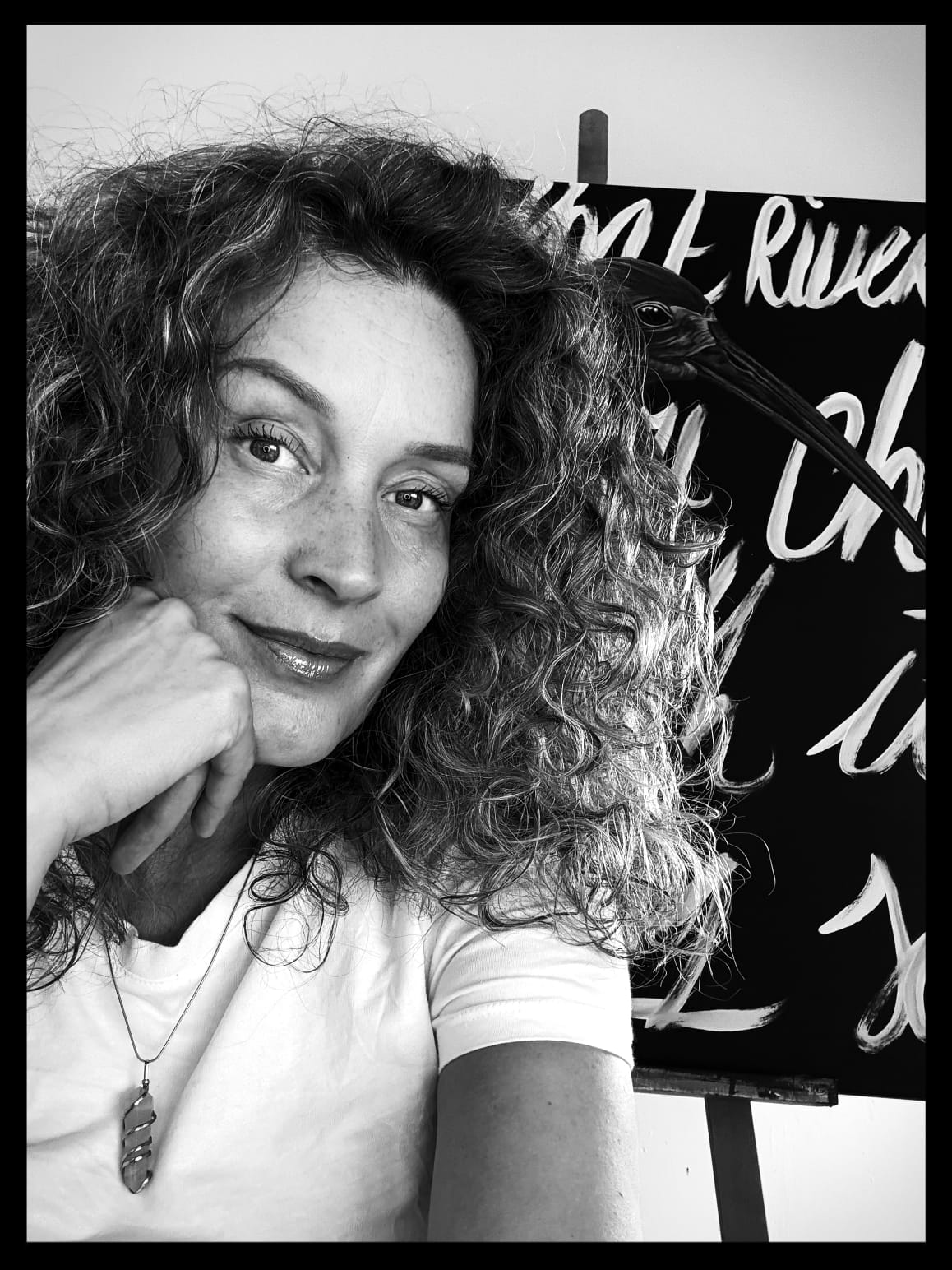
Esther Claus is a multidisciplinary artist, poet, and holistic healing practitioner based in Amsterdam, Netherlands. Through painting, poetry, and symbolic storytelling, she explores the profound intersections of healing, spirituality, consciousness, family, and the human experience.
Working primarily in acrylics, Esther creates semi-realistic and surreal artworks that transform invisible emotional and spiritual dimensions into powerful visual narratives. Her acclaimed Soul Portraits series reveals the unseen bonds between people through the symbolic language of plants, animals, and nature, while her Poetry Album Project reimagines the traditional keepsake album as a timeless expression of memory, love, and human connection.
Drawing inspiration from mythology, herbal wisdom, dreams, shamanic traditions, and the natural world, Esther’s work invites viewers to slow down, reflect deeply, and reconnect with their intuition. Alongside her artistic practice, she writes about conscious parenting, emotional healing, creativity, and personal transformation, encouraging others to embrace authenticity, compassion, and inner growth.
Today, Esther continues to create work that celebrates the invisible threads connecting people, nature, and consciousness, reminding us that art can be both a mirror for the soul and a pathway toward healing.
Welcome to an extraordinary conversation that bridges the worlds of profound trauma healing, raw emotional visibility, and the sacred craft of traditional master painting. Sundram Kumar sits down with Amsterdam-based artist Esther Claus to explore her journey across seven thoughtful chapters.
Chapter 1: Healing, Silence & Inner Transformation
1. You have shared that spirituality and meditation played an important role in helping you heal from severe childhood trauma. When you first experienced deep inner silence, did it feel unfamiliar and frightening, or did it feel like returning to something you had always known?
The depth and silence I am referring to is something I only truly experience while painting. In that state of deep focus and stillness, it feels as if the world comes to a halt. My mind stops racing, and I find a profound sense of peace there. It is also the space where miracles seem to happen, where everything around me fades away and I fully surrender to the energy of creation.
Because I have been painting for over 26 years, I believe it has had a deeply positive influence on my emotional state. I only discovered at the age of 43 what trauma had occurred in my early childhood, around the age of six. Looking back at my life, I feel that painting has quite literally kept me sane. It allowed me to remain present, day after day, anchored in the moment.
I began meditating in 2017, and it has since become my daily evening ritual. It is a moment I genuinely look forward to, as I intuitively allow myself to be guided in working with my energy. Sometimes this involves breathing techniques, sometimes visualisation, and sometimes more somatic practices, but it always ends in a state of deep rest.
For about 40 years, my body lived in a constant state of extreme stress response, especially in the evenings. This happened unconsciously, because I did not know any different and assumed this was simply my normal state.
In 2017, I started wearing a heart rate monitor. The intention was to better understand my stress levels so that appropriate minerals and vitamins could be selected. The results showed that every night, around the same time, my body was entering a state of extreme stress. A second opinion was required because of how consistent and intense it was. This became the beginning of my meditation practice, and also the beginning of many answers rising to the surface, truths that had been hidden underneath, patiently waiting to become visible.
2. Looking back now, what do you believe was the most important step in your healing journey?
There have been several very important steps and decisions I have made over a long period of my life, but I think the most significant one was reaching out for help, specifically through hypnotherapy. That step had the deepest impact, because it felt as if my inner world literally shifted.
It felt like I was being handed the final missing puzzle piece, and suddenly everything started to fall into place. In those sessions, it was as if I was able to put down a very heavy backpack I had been carrying for a lifetime. I experienced deep forgiveness, and I was empowered through the realisation that my intuition had always been accurate and guiding me correctly. In that moment, everything changed. I gained a new perspective and could see my life more clearly from above, almost as if I was observing it from a higher vantage point. It was one of the most intense periods of my life, a time of profound grief, but also of a completely new beginning. A true rediscovery of the self.
3. You once said that “you have to get silence to really hear.” What do you think people today have become unable to hear because modern life is so noisy?
I think modern life is very distracting. Everything seems to be designed in a way that pulls your attention away and prevents you from truly focusing. There is constant noise, external, but also internal and very little space is created for stillness. Because of that, I think many people have become unable to really hear themselves anymore. Not just in the sense of thoughts, but also in terms of intuition, body signals, and inner knowing.
4. If you could send one of your current artworks back to your younger self, which piece would you choose, and what would you hope she would understand from it?
I would show my younger self my family portrait. At first, I think she would be completely shocked to see her older self there as a single mother. But the two cats in the painting would probably soften the blow and make her laugh, they would reassure her in their own way.
What I would really want her to see, though, is that she is about to walk a very unique and meaningful path. That everything she will go through is not random, but part of a deeper unfolding. I would want her to understand that all the external criticism she will encounter along the way can be gathered, transformed, and ultimately turned into strength and self-confidence. That nothing she experiences is wasted, it all becomes material for who she is becoming. And most importantly, I would want her to feel that she will not only survive her story, but that she will one day be able to create beauty from it.
5. You documented a deeply personal milestone in your writing titled “Breaking Up With Alcohol.” When you finally stripped away that emotional buffer, what did you discover about your raw, unedited relationship with your own creative and spiritual energy?
I have always been very aware of the patterns within my family. Growing up, the use of alcohol was present every day. I understood that I was not only responsible for breaking my own pattern, but also for what I would pass on to my son. I knew that for me, the cycle of addiction had to stop.
I drank mainly to be able to fall asleep. So when I truly reached the point where I was done with it, sleep initially became difficult again. But over time, I have learned how to function with very little sleep, and I experience that even though my sleep pattern is different now, I feel significantly better without alcohol in my system. Rose colored lenses were removed.
I am more connected to my body, and my intuition feels sharper. My ability to create has not diminished at all; the ideas still come just as strongly. Nothing about my creativity changed, and I never truly feared that it would. That trust is deeply rooted in me, because I understand how creative energy works. For me, it is quite simple: you are the channel. And when you are deeply connected to yourself, it becomes more like a natural flow that you can listen to and then translate into action.
6. During your spiritual journey, were there moments when you lost faith, not necessarily in spirituality itself, but in yourself or your ability to heal? How did you find your way back?
Oh, absolutely. There have definitely been moments when I asked myself, Why do I have to carry all of this on my own? This isn’t fair. Moments when I slipped into a victim mindset or caught myself giving my power away. But over the years, I have noticed a pattern. Those moments almost always come just before a breakthrough or a significant shift. It’s as if the old part of me has one last chance to speak before something new emerges.
I think the biggest difference now is awareness. I recognize what is happening while it’s happening. I allow myself to feel it. If I need to cry, I cry. If I feel disappointed or exhausted, I let myself experience those emotions without judging them. The difference is that I no longer live there. Usually, those moments last no more than a day. My default mindset is no longer, “Why is this happening to me?” but rather, “What is this trying to teach me?” or “Which direction do I actually want to move in?” And once I have that answer, I take action. Healing, to me, isn’t about never falling. It’s about learning to trust that every setback carries information, and that I always have the choice to return to myself with compassion, curiosity, and courage.
Chapter 2: Sensitivity, Identity & Purpose
7. You describe yourself as someone who translates “sensitivity and soul wisdom into art.” When did you first realize that your sensitivity was not a weakness, but one of your greatest strengths?
I don’t think there was one defining moment. It was something I gradually came to understand over the years. From a young age, I noticed that I often triggered people. Sometimes simply by being present, but more often during conversations. For a long time, I didn’t fully understand why. Later, I realized that I naturally hear what is not being said. I can sense what lives beneath the words, the emotions people hide, and the stories they have not yet found the courage to tell.
Speaking those truths is like shining a light into places that have remained in the dark. Not everyone welcomes that. When people are not ready to face what they have buried, they often resist the person holding up the mirror. Throughout the years I’ve learned that there is often no need to express that.
For many years, I thought this sensitivity was something I needed to tone down. But eventually I understood that it was never a weakness, it was one of my greatest gifts. My sensitivity has become my internal navigation system. I have learned to trust my intuition, even when there is no logical evidence to support what I feel. It is not about making assumptions; it is about recognizing subtle patterns, energy, and what my body quietly knows before my mind can explain it. That same sensitivity also taught me something very important: not everyone deserves access to my energy. It became a compass that helps me recognize where my presence can truly contribute and where it is healthier to step away. It is the same compass that guides my art. I don’t begin a painting by trying to control the outcome. I begin by listening. I trust that creative energy already knows where it wants to go, and my role is simply to become quiet enough to receive it. Looking back, I realize that what I once tried to hide has become the very foundation of both my healing and my work as an artist.
8. Your platform is called The Woman with the Kite. What does the kite symbolize for you today?
The kite symbolizes my higher self, my higher perspective. It reminds me that there is always another way of looking at life, especially when we find ourselves in the middle of difficult seasons. For me, the kite represents ascension. It is the belief that our hardest lessons often carry our greatest wisdom. That we can transform our inner monsters into flowers, our wounds into something meaningful, and our pain into compassion and creativity. The person holding the kite isn’t fighting against the wind, they have the wind behind them. That image reminds me that life is not only about surviving adversity. It is also about allowing yourself to be lifted by everything that is beautiful, loving, and worth being grateful for. The kite also symbolizes trust. You cannot control the wind, but you can learn to work with it. In many ways, that is how I see life, creativity, and spirituality. We cannot control every circumstance, but we can choose how we respond. When we trust our inner guidance, even the strongest winds can help us rise rather than pull us down.
9. How do you transform emotions, memories, and spiritual experiences into colors, textures, and visual symbols?
From a young age, I have been fascinated by symbolism, especially the symbolism found in dreams. I still dream very vividly, and for more than 35 years I have been exploring and interpreting my dreams. Along the way, I developed a deep interest in animal symbolism, holistic medicine, and the wisdom of plants. Over the years, I have built a collection of books that explore their symbolic and healing qualities. At some point, these two worlds naturally came together in my art.
When I begin a portrait commission, I don’t start with the painting, I start with a conversation. I want to know who you are. What has shaped you? What are your values? What experiences have made you the person you are today? Once I have that understanding, I let the creative process unfold naturally. I simply pay attention to what comes into my awareness. Sometimes a specific animal, flower, or natural element immediately comes to mind. Other times, I begin researching through books, the internet, or libraries, following my intuition until something feels unmistakably right.
I have learned to trust that process completely. The right symbols always seem to find me. Every symbol I include in a portrait has a reason for being there. I always provide the client with a written explanation of the symbolism, and time and time again, people tell me how deeply it resonates with them. It often reflects aspects of themselves that they already sensed but had never been able to put into words. For me, symbolism is more than decoration. It is a language that allows me to tell someone’s story without saying a single word.
10. In a digital world that constantly asks people to seek attention and online visibility, you wrote, “The Wild Rose Doesn’t Chase the Bee.” How can an artist find the courage to trust their own rhythm instead of constantly seeking approval from others?
First of all, I think constantly seeking approval from others is one of the most exhausting things you can do. Every time you rely on someone else’s opinion to determine your worth, you give away a little of your own power. That doesn’t mean feedback isn’t valuable. It is. But there is a big difference between being open to feedback and becoming dependent on validation.
I don’t create my art to be liked by everyone. I have made peace with the fact that my work will not resonate with every person who sees it and I don’t think it should. The right art finds the right people. I know who I am as an artist. I know how deeply committed I am to my work, how much time I dedicate to it, and how intentional every piece is. No one else’s opinion can define that for me.
For me, it all comes down to trust. Trust that the people who are meant to connect with my work will find it. Trust that I don’t have to chase every opportunity, but that I do have to show up consistently, move towards the places where my work belongs, and build collaborations that are genuinely meaningful for everyone involved. That is exactly what I meant when I wrote, “The Wild Rose Doesn’t Chase the Bee.” A wild rose simply blooms. It doesn’t spend its energy chasing attention. It becomes fully what it was created to be, and because of that, the bee naturally finds its way to the flower. I believe the same is true for artists. When your vision is clear, when your work is authentic, and when you remain faithful to your own rhythm, you stop creating for approval and start creating from purpose. And that, in my experience, is where the most meaningful connections are made.
11. You describe yourself as a “Visionary Spiritual Rebel.” What are you rebelling against?
When I describe myself as a Visionary Spiritual Rebel, I am not talking about rebelling against society for the sake of being different. I am talking about having the courage to live in alignment with your own truth, even when it goes against expectations. I believe that in today’s world, one of the most rebellious things you can do is to listen to your heart and trust your intuition.
It means not blindly following the crowd simply because something is popular or socially accepted. It means choosing the path that feels true to you, even when it is the more difficult one. It means making decisions based on your values rather than other people’s expectations. To me, being a spiritual rebel also means not being afraid to walk alone for a while. Growth often asks us to leave behind familiar people, beliefs, or environments before we discover where we truly belong. That can feel lonely, but it is also where authenticity is born.
For me, rebellion isn’t loud. It isn’t about fighting the world. It is the quiet courage to keep choosing yourself, your purpose, and your inner guidance, even when no one else understands it yet. Because every meaningful change, whether personal or collective, begins with one person who is willing to trust their own vision before the rest of the world can see it.
12. Living with an “open channel” means experiencing both beauty and pain very deeply. How do you keep this channel open and true without becoming overwhelmed by the modern world?
Living with an “open channel” is not something I can really switch off. Of course, there are ways to protect myself, but I don’t feel the need to close it down. I’ve learned to recognize very clearly when something is not mine, and I don’t hold onto it when that’s the case. I’m quite intentional and careful with where I place my attention and what I allow in. That awareness alone already creates a natural boundary. Grounding is also an essential daily practice for me; it keeps me balanced, present, and connected to my body and the physical world, so I don’t get lost in the intensity of what I feel or perceive.
Chapter 3: Motherhood, Sensitivity & Human Development
13. You have spoken beautifully about raising a highly sensitive child. How has becoming a mother changed your understanding of human nature?
Becoming a mother has expanded my understanding of human nature far beyond the physical. Through my son, I became more aware of soul contracts, the idea that we meet each other as mirrors, and that we are ultimately consciousness and energy rather than separate beings moving through linear time.
Motherhood opened a deeper layer of perception for me. Experiences around astral travel, remote viewing, and channeling have become part of an inner landscape that feels very natural, almost like remembering something rather than learning it. At the same time, my son has grounded me in the most simple and profound truth: unconditional love. He has shown me that love is not something you explain or control, it simply is. And through him, I experience both the mystery and the simplicity of being human at the same time.
14. What does it mean, in practical daily life, to raise a child through a spiritual rather than a purely conventional perspective?
The practical side of raising my son in a more spiritual way was very simple and grounded in daily routines when he was younger. Before leaving the house, we would do a short grounding practice together, and at bedtime we had a small ritual to release the day. Those were the two consistent things we did every day. Now that he is older, he naturally does these things himself. Another important aspect is awareness of emotional energy. My son is very sensitive and feels everything. I notice that when I am stressed, he picks up on it immediately. He mirrors it, either through his behavior or through situations that reflect what is happening internally in me. That awareness has made me very responsible with my own inner state.
I grew up in a generation where children were often not told or explained certain emotional things. But as a sensitive child myself, I felt everything, and when you are told that nothing is wrong, you start to doubt your own perception. Because of that, I make a conscious effort to communicate openly with my son and to acknowledge his feelings rather than dismiss them.
15. How do you help a sensitive child remain open-hearted while also learning to protect themselves?
My son’s intuition is very strong, and he trusts it. That has also contributed to his confidence. When he has doubts, he comes to me and we talk it through, and I give him feedback from my perspective. Over the past 14 years, I have not seen him withdraw or shut himself down, even in overwhelming situations. I have also learned that emotions like disappointment, sadness, and anger are a natural part of life. It is important that children are allowed to feel those emotions fully, to cry, to be angry, but also to understand that they have a choice in how long they stay in that state, and how they move through it again. When he was very young, especially in busy school environments, I would teach him simple imaginative tools, like visualizing a glass dome around himself or putting on a kind of superhero suit. It helped him feel more protected and less overwhelmed in those moments. He doesn’t use those techniques anymore, but they served him well at that stage of development.
16. Has your son’s way of seeing the world changed the way you create art?
Not in the way he sees the world directly, no. But my son has shown me certain pain points that were still living within me. Through him, I became more aware of things I had not fully processed yet. Because of that awareness, and the willingness to change, I started to shift internally. And that inner shift naturally influenced my work as well. It changed the way I approach painting, as well as the themes I choose to explore through my art and projects.
17. What has your son taught you that no book, teacher, or spiritual tradition ever could?
For me, it is simple: he has taught me what unconditional love truly feels like, as a lived, daily experience. Through him, I understand love in a way that is direct and beyond explanation.
18. Do you believe society understands highly sensitive children, or do we still have much to learn?
We still have a lot to learn. At the moment, we tend to label sensitive children very quickly and place them into fixed boxes, rather than really trying to understand what they are communicating. To me, these children are not “problems to be solved,” but they are showing us a different way of perceiving and processing the world, one that is less rooted in pure rational thinking and more in deep feeling and awareness.
I also believe there is an important role for education here. It would help if schools placed more emphasis on emotional development, grounding, and self-awareness, alongside academic learning. Many children would benefit from being supported in how to work with their energy, rather than simply trying to suppress or correct their behavior. And at the same time, I think there is also a need for more awareness among parents about the impact of overstimulation, especially through constant digital input like iPads, phones, and computers and how that affects a child’s nervous system and sense of calm. In many cases, we are still looking for quick fixes, when what is actually needed is more understanding, presence, and time to truly see the child.
Chapter 4: Art, Craft & Creative Practice
19. Your foundation as a trained Meester Schilder (Master Painter) combines discipline with creativity. How has traditional craftsmanship shaped your artistic voice?
I have mainly used traditional craftsmanship in the large-scale work I did for clients such as the Dutch Opera and ballet companies. There, I paint on the floor with long-handled brushes, which requires a very physical, disciplined approach to painting. Mastering that technique has allowed me to support myself across different areas and, at the same time, continue developing my own autonomous practice.
Last year, however, new government regulations were introduced, which led many of these larger institutions to stop working with freelancers. As a result, I became more dependent on my independent artistic work. In a way, that shift felt both necessary and timely, but it also brought a new period of uncertainty, one that is still unfolding.
20. When working with traditional materials and techniques, do you ever feel connected to artists and craftspeople who lived centuries before you?
Yes, absolutely. To be honest, I sometimes joke about it, but there is also a very real feeling of connection there. When I am not fully in my flow, especially when I’m working on something like a portrait, I’ll literally say: “Okay Rembrandt, help me out here.” Or when I was working on a mural a few months ago inspired by the Dutch master Ruysdael, I would say: “Alright Ruysdael, talk to me.” In that sense, I do feel a living connection with the old masters.
In my studio, I also have an image of Frida Kahlo holding a gun hanging behind me on the wall. I like to think she has my back. Beyond that, I genuinely feel supported in the process. I experience my spirit team as present during deep creative focus, and sometimes I even sense figures standing behind me while I work. Whether you see that symbolically or literally, for me it is a way of acknowledging guidance beyond myself and I always take a moment to thank them.
21. In your essay Don’t Dim Me, you write about refusing to make yourself smaller for others. Where do you find the courage to remain fully yourself?
For a long time, I adapted myself. I constantly felt like I was too much. I made myself “easy to digest” for many people, but at a certain point it simply stopped working. I was drifting further and further away from myself. I noticed that I was having to give up too much of my own happiness just to maintain certain relationships, with family members, friends, and dynamics that no longer felt aligned. At some point, I made a very conscious decision to step away from that. I broke ties with certain people and began moving back toward my own happiness, and toward the woman I truly am underneath all of that conditioning.
22. What do you think society loses when art becomes viewed primarily as a product rather than as a human experience?
When art becomes viewed primarily as a product rather than a human experience, we lose a sense of wonder and emotional depth. We start to approach art through value, speed, and consumption, instead of presence and connection. And in that process, something essential disappears: the space to feel, to be moved, and to truly slow down with what is being expressed. Art then becomes something we look at, rather than something we experience.
23. In an age increasingly shaped by technology and artificial intelligence, what does creating something slowly and by hand mean to you?
If you understand that everything created carries a form of awareness, then creating with your highest intention is almost like bringing life into a painting. It becomes something that holds presence. AI can generate images in seconds, but it does not have a nervous system, it does not feel, and it does not carry lived experience. It follows instructions, whereas handcraft is deeply emotional and embodied. In that sense, it cannot compare to the depth of human-made work.
For me, creating slowly and by hand is also about patience and devotion. It is not about producing something in three seconds, but about allowing time for something to mature through you. Skill, sensitivity, and depth are built over years. When I look back 26 years, I see a completely different level of where I started compared to where I am now. That evolution is only possible through consistency, discipline, and devotion to the craft over time.
Chapter 5: The Living Book & Human Connection
24. Your project, “Written to Remain,” combines twelve collage paintings with twelve poems and is inspired by a largely forgotten Dutch tradition. What drew you to this tradition in today’s digital world?
My project What Lives On, Written by Those Who Love You began with a very personal question: what do I actually leave behind for my son? Around the same time, I was cleaning out a cupboard and found my own poetry album from when I was around six years old, something I hadn’t seen in 40 years. It was a book with empty pages that was passed around among family and friends, where people would write poems, messages, and add small drawings or images. That discovery felt like a direct reminder of something meaningful that has almost been forgotten.
What made it even more powerful is that I still have this book because of the people who wrote in it. Some of them are no longer here, so it carries an emotional layer that goes beyond the pages themselves. Their handwriting now holds even more meaning than it did at the time. I felt inspired to bring that tradition back, but in a more contemporary form, almost like giving it a new, adult layer. Because in the end, when my time here is done, what remains are not devices or digital conversations, but words that carry love. Our phones might be buried with us one day, and no one will remember a random chat thread or an app conversation. But written words, especially those rooted in love and intention, can become something lasting. For me, it’s about sharing wisdom and love in a tangible way again, creating something that can become a kind of treasure chest for the person who holds it.
25. You chose to leave blank pages between the works so that others can contribute their own thoughts and experiences. Why was it important that the book become a shared creation rather than remain only your own?
It is a very personal book for the owner. It can become something of great emotional value. By leaving blank pages, the book becomes an invitation rather than a finished object. It allows others to contribute their own thoughts, memories, and experiences, which makes it alive in a different way. The words of our loved ones, written specifically for you, carry a different weight. They become a kind of proof that we existed, and that we loved each other. There is also something very powerful in the slowness of it. It creates space to pause, to reflect, and to be intentional with the words you choose to give someone. In a world where so much is instant, that act of slowing down becomes almost sacred. The book becomes something deeply meaningful that holds connection, presence, and love.
26. You describe this project as “an analog product in a digital world.” What do you think modern society is losing as more of our lives move online?
We are losing focus. The ability to truly be with something, without constantly being pulled away.
27. As this book travels between people, it will gather fingerprints, handwriting, stains, and memories. Do you see these imperfections as damage, or as part of the artwork itself?
Definitely a part of the artwork itself. These traces are not damage to me, they are life. And life is imperfect and that is completely fine. As the book moves from person to person, it naturally gathers fingerprints, handwriting, and small marks of time. It actually becomes a living archive of human presence and connection.
28. You have said that you hope this project might one day become a worldwide tradition. What would humanity need to rediscover in order for that dream to become possible?
I think we would need to rediscover the awareness that life is short, and that we don’t outlive this planet. That alone changes how we relate to each other and to what we choose to leave behind. We carry wisdom, experiences, and emotions that are meant to be shared, not stored away or forgotten. And at the core of it all, I believe love is the only energy that truly remains. When we create from that place, something like this project naturally becomes meaningful again.
Chapter 6: Society, Change & Human Experience
29. How do you protect your creative space from the constant pressure of social media and digital visibility?
By ignoring algorithms. I post when I feel it is right for my work, not when a system tells me to. I don’t follow trends or formulas. I stay close to how I want to present my work and how it feels aligned with my practice. For me, social media is more of an echo of the real world than the place where my art actually lives. It supports my work, but it doesn’t define it.
30. You have chosen to include themes such as menopause in your recent work. Why do you think society still struggles to speak openly about this important stage of life?
We are the first generation that is starting to speak openly about this important phase in women’s lives. For a long time, we come from a collective culture where we simply didn’t talk about our struggles, or the deep internal changes we go through as human beings. These experiences were often kept private, or even silenced, which created a sense of isolation around something that is actually deeply natural. I think we are now slowly beginning to shift that. There is more space emerging for honesty, for sharing, and for acknowledging that these transitions are part of life rather than something to hide.
31. You have written about the dangers of endless digital distraction. How do you protect your imagination and inner life from being overwhelmed by technology?
I am very aware of my own use of technology, and because I spend so much time painting, I really notice the difference in how my mind feels. If I paint for a day, or if I have to work behind a laptop for a day, the contrast is very clear. After a day on the laptop my mind feels cloudy and my head feels tired, whereas that doesn’t happen when I spend the day painting. The physical act of creating keeps me much more grounded and present. To return to myself, I journal. I try to write around three pages every evening. It helps me reflect, calm down, and reconnect with my inner world. It is a simple practice, but for me it is very powerful in staying close to myself.
32. Many people use spiritual language to avoid difficult emotions and realities. How do you keep your own spiritual practice honest, grounded, and connected to everyday life?
It is about balance and about understanding that all emotions are part of the human experience. Life is not always light or pleasant, and I believe we often give meaning to emotions after the fact, but in essence they are all signals that tell us something about ourselves. I have also experienced moments of disappointment with people who present themselves as spiritually aware, but who struggle when their own shadows are being reflected back to them. In those moments, instead of openness, there can be avoidance or projection. For me, that also says something about where we are collectively. Because of that, I try to keep my spirituality very grounded and personal. It is not something I use as a label or something I perform outwardly. It is something I live with, in how I relate to myself and to everyday life.
Chapter 7: Legacy, Meaning & The Human Journey
33. When you were younger, you encountered the idea that “you decide for yourself when you want to be happy.” How has your understanding of happiness changed over the years?
I made that decision when I was 23 years old. I started to observe my thoughts more consciously and to actively transform negative thinking into more supportive perspectives, and I noticed how that shifted my life. That was the moment I began to truly feel happiness in a more stable way. That feeling has become my reference point. Over time, I have also been pulled away from it during more difficult periods in life. But because I have experienced it so clearly before, I know my way back to it. What has changed over the years is that I now understand happiness less as a constant state, and more as something I can return to. It is not something I permanently hold, but something I remember and reconnect with.
34. Has your relationship with mortality and the temporary nature of life changed as you have grown older? Has it changed the way you create?
Yes, it has changed profoundly. When I was growing up, my parents spoke very openly about the afterlife. During dinner they would tell my brother and me stories about spirits and life beyond death. At the time, we were terrified. Our bedrooms were in the attic, and the last thing we wanted was to meet a ghost on the way to the bathroom in the middle of the night. As I grew older, however, I became deeply grateful that these conversations were part of my childhood. They gave me a relationship with death that is very different from what I often see around me.
For me, death does not feel like an ending. I experience it as a returning home. I see this life as an experience for the soul, and I believe that the people we love are not truly gone, they exist on another level of consciousness. That belief brings me a great sense of peace. The feeling I associate with death is actually similar to the last day before the long summer holidays when I was a child: a sense of freedom, excitement, and coming home to something familiar. My son’s experiences with astral travel have strengthened that feeling even more. Through him, I have come to experience how close our loved ones still are, and I find that deeply comforting. As an artist, this has also changed the way I create. It has made me less interested in making objects and more interested in creating work that carries love, memory, and connection, something that can outlive me and continue to speak long after I am gone.
35. If everything else disappeared-your paintings, your books, your achievements-what is the one truth about being human that you would most want future generations to remember?
I hope people remember that they are allowed to live fully. To feel everything. To transform pain into wisdom, fear into courage, and love into something that can be passed on. We are only here for a short time. We don’t take our achievements with us, but we do leave behind the way we loved, the way we created, and the lives we touched. To me, that is what it truly means to be human.
36. Looking back at your journey through art, motherhood, healing, spirituality, and life itself, what does it mean to you today to remain true to yourself and to keep your “open channel” alive in a world that does not always understand it?
It means everything to me. For a long time, I thought I had to make myself smaller in order to fit into the world around me. Today, I no longer feel that way. I honor who I am, including my open channel, because I have come to see that it is not something I need to fix or hide, it is one of my greatest gifts. I am deeply grateful for this life, with all its beauty and all its challenges. I feel that I am the creator of my own experience. I may not be able to control everything that happens to me, but I can choose how my mind responds, what I create, and how I want to live. To remain true to yourself means continuing to follow my heart, even when that path is unconventional. It means trusting my intuition, staying curious, and creating from a place of love rather than fear. I look forward to everything that is still waiting for me. Life feels like an extraordinary adventure, and I have the privilege of decorating it in a way that reflects who I truly am.